Nomi
UPF Food Scanner
Know what’s really in your food
Get the free app

Bread

Barcode 4335619181908
Ultra-Processed Food (UPF)

Yes — Bread is ultra-processed.

Not a great choice for everyday.

This is bread made primarily from wheat flour, water, rapeseed oil, yeast, and sourdough ingredients. It is classified as ultra-processed because it contains dextrose, an industrially processed isolated sugar; sodium carbonates, a pre-identified UPF raising agent; and calcium propionate, a pre-identified UPF preservative. It also contains several flour-treatment and processing additives, including L-cysteine and ascorbic acid.

Ingredients

3 ultra-processed markers
  • OK
    wheat flour (wheat flour, calcium carbonate, niacin, iron, folic acid, thiamin)
  • OK
    water
    Essential base ingredient for countless foods and beverages; serves as solvent and texture modifier.
  • OK
    rapeseed oil
    A basic culinary oil pressed from rapeseeds (Brassica napus). Used for frying, baking, and dressings. Neutral flavor.
  • OK
    yeast
    A living microorganism used as a leavening agent in baking.
  • OK
    fermented wheat flour
    Wheat flour that has undergone fermentation, typically with yeast or lactic acid bacteria, used to help leaven or alter flavor in baked products.
  • OK
    wheat flour
    Finely ground cereal flour from wheat; a fundamental baking ingredient.
  • OK
    salt
    Common mineral compound (sodium chloride) used as a seasoning and preservative across cuisines.
  • OK
    rice flour
    A finely milled flour from milled rice, commonly used as a gluten-free thickener or flour substitute in baking and cooking.
  • UPF
    dextrose
    A simple sugar derived from glucose. Commonly used as a sweetener and source of quick energy in foods.
  • OK
    calcium sulfate (acidity regulator)
    A mineral-based acidity regulator additive used in food processing.
  • OK
    citric acid
    A weak organic acid found in citrus fruits, commonly used as an acidulant and preservative in foods and beverages.
  • UPF
    sodium carbonates raising agents
    Leavening agents containing sodium carbonate (soda ash) used to produce carbon dioxide for doughs and batters.
  • OK
    ammonium carbonate
    A leavening agent historically used in baked goods; releases ammonia and carbon dioxide when heated, producing a light texture.
  • OK
    flour treatment agents: l-cysteine
  • OK
    ascorbic acid (vitamin c)
    A water-soluble vitamin (vitamin C) used as an antioxidant and preservative in foods.
  • OK
    malted barley
    Malted barley is barley that has been soaked, germinated, and dried to convert starches into fermentable sugars. Commonly used in brewing and baking.
  • OK
    wheat sourdough
    Fermented dough made from wheat flour; traditional leavened bread base.
  • UPF
    calcium propionate
    Calcium propionate is a synthetic calcium salt used as a preservative to prevent mold and extend shelf life in baked goods and some dairy products.
  • OK
    wheat starch
    Starch extracted from wheat grain, used as a thickener, filler, or texture modifier in foods.

Common questions about Bread

Is Bread ultra-processed?

Yes — Bread is ultra-processed, so it counts as a UPF (ultra-processed food). This is bread made primarily from wheat flour, water, rapeseed oil, yeast, and sourdough ingredients. It is classified as ultra-processed because it contains dextrose, an industrially processed isolated sugar; sodium carbonates, a pre-identified UPF raising agent; and calcium propionate, a pre-identified UPF preservative. It also contains several flour-treatment and processing additives, including L-cysteine and ascorbic acid.

Which ingredients in Bread are ultra-processed?

Nomi flags 3 ingredients in Bread as ultra-processed markers: dextrose, sodium carbonates raising agents, calcium propionate. See the full ingredient breakdown above for what each one is.

What does "ultra-processed" (UPF) mean?

Ultra-processed foods (UPFs) are industrial formulations made with ingredients and additives you wouldn't find in a home kitchen — such as emulsifiers, artificial flavourings, colourings and modified starches. The classification is based on the NOVA system used by researchers and dietitians worldwide.

How can I check whether other foods are ultra-processed?

Scan any barcode — or photograph the ingredients label — with the free Nomi app for iOS and Android. You'll get an instant ultra-processed verdict with every ingredient explained in plain English.

BBC As seen on The One Show

Scan it yourself,
right in the aisle

This page was shared from Nomi, the free app that tells you instantly whether any food is ultra-processed.

  • Scan any barcode — or photograph the ingredients label
  • Every ingredient explained in plain English
  • Daily check-ins show how food affects how you feel
  • Save favourites and build a healthier shopping list

Free download · No subscription needed to start scanning
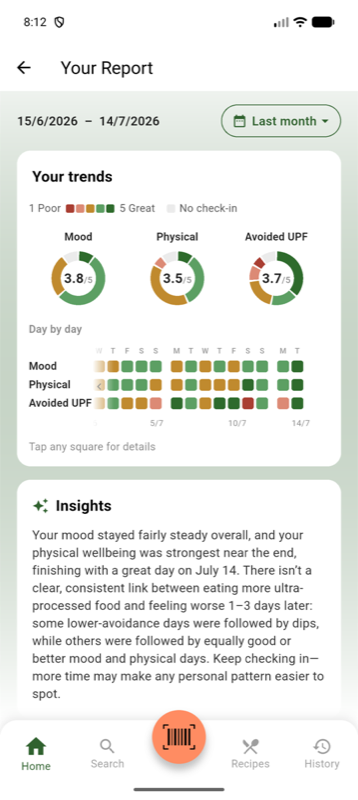
Nomi monthly wellbeing report
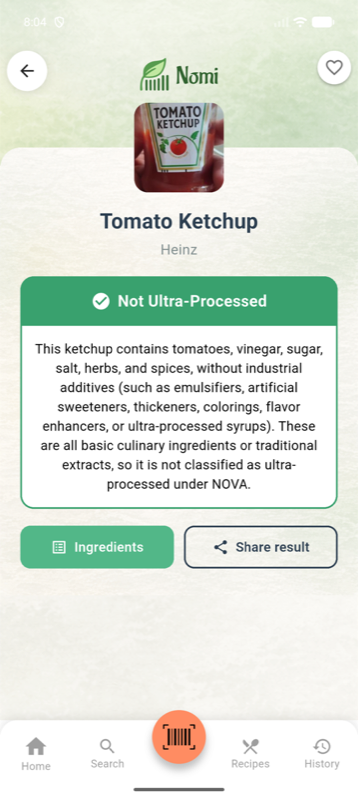
Nomi scan result screen

Product information comes from public databases and Nomi's own analysis, and may contain errors. Always check the packaging. Ultra-processed classification is based on the NOVA food processing system.

Nomi — UPF Scanner Free on iOS & Android
Get the app