Nomi
UPF Food Scanner
Know what’s really in your food
Get the free app

Chocolate Orange Biscuits

Barcode 5000168039947
Ultra-Processed Food (UPF)

Yes — Chocolate Orange Biscuits is ultra-processed.

This product is classified as ultra-processed (UPF) according to the NOVA system because it contains several industrial ingredients and additives. In particular, it includes glucose-fructose syrup, dextrose, and glucose syrup (industrially refined sugars); vegetable fats (palm, shea) and vegetable oils (sunflower, palm), including refined palm fat; multiple emulsifiers (soya lecithin, e476); humectant (glycerine); gelling agent (pectin); acidity/acid regulators; colour (curcumin); and natural flavouring / natural orange flavouring. These are all markers of industrial formulation beyond basic culinary processing. The presence of any one of these would be sufficient to classify it as UPF; the combination of many such additives confirms it.

Ingredients

13 ultra-processed markers
  • UPF
    glucose-fructose syrup
    A commercially produced sweet syrup made by hydrolyzing and blending glucose and fructose sugars; widely used as a sweetener in foods and beverages.
  • OK
    dark chocolate
    A chocolate product with cacao mass and cocoa butter, typically containing sugar and milk solids; here specified at 19% cocoa content.
  • OK
    sugar
    Granulated sugar derived from sugarcane or sugar beets; a basic, single-ingredient sweetener.
  • OK
    cocoa mass
    Ground or melted cocoa beans; pure cocoa solids used for chocolate making.
  • UPF
    vegetable fats (palm, shea)
    A blend of tropical vegetable fats, commonly used for baking and confectionery applications; includes palm oil and shea fat.
  • OK
    butter oil (milk)
    Fat component derived from milk, used as a dairy fat or spread; often included in chocolate or bakery products.
  • OK
    cocoa butter
    A fat extracted from cocoa beans, used in chocolate, cosmetics, and baking as a fat component.
  • UPF
    emulsifier (soy lecithin, e476)
    A food additive used to stabilize emulsions; E476 refers to polyglycerol polyricinoleate (PGPR), often used to improve texture and shelf-life.
  • UPF
    natural flavouring
    A generic flavoring ingredient derived from natural sources used to impart aroma or taste; may include essential oils or extracts.
  • OK
    flour
    Fine powder obtained by grinding cereal grains; commonly refers to wheat flour in many contexts.
  • OK
    wheat flour
    Finely ground cereal flour from wheat; a fundamental baking ingredient.
  • OK
    calcium
    Mineral supplement; not a food ingredient by itself but can be added to foods as fortification. Typically not consumed alone as a food.
  • OK
    iron
    Essential mineral used as a nutrient or fortifying ingredient in foods.
  • OK
    niacin (vitamin b3)
    A water-soluble vitamin used as a nutrient and often added to foods as a fortifying vitamin.
  • OK
    thiamine
    A water-soluble B vitamin (vitamin B1) used as a nutrient and fortification additive.
  • OK
    whole egg
    A whole chicken egg including yolk and white, used as a binding, enriching, and leavening ingredient in many recipes.
  • OK
    water
    Essential base ingredient for countless foods and beverages; serves as solvent and texture modifier.
  • UPF
    dextrose
    A simple sugar derived from glucose. Commonly used as a sweetener and source of quick energy in foods.
  • OK
    orange juice concentrate
    Juice from oranges with water removed to concentrate sugars and flavors.
  • UPF
    glucose syrup
    A processed syrup made from starch (usually corn) consisting mainly of glucose; commonly used as a sweetener and thickener.
  • UPF
    vegetable oil (sunflower, palm)
    A blend of refined vegetable oils from sunflower and palm sources. Used as a basic cooking oil.
  • UPF
    glycerin (glycerol)
    A humectant used to retain moisture in foods and to improve texture; often added as a sweetener or stabilizer.
  • UPF
    citric acid
    A sour-tasting organic acid used as an acidulant and preservative in foods. Commonly added in small amounts to adjust acidity.
  • UPF
    pectin
    Natural polysaccharide extracted from plant cell walls used as a gelling agent in jams, jellies, and confectionery.
  • OK
    raising agents (disodium diphosphate, ammonium bicarbonate, sodium bicarbonate)
    A blend of leavening compounds used to release gases in doughs and batters, enabling rising. Includes disodium diphosphate, ammonium bicarbonate, and sodium bicarbonate.
  • OK
    dried whole egg
    Dried eggs obtained by removing moisture, used as a convenient source of protein and functional binder.
  • OK
    sodium bicarbonate
    A basic leavening agent and acidity regulator (baking soda) used to neutralize acids in doughs and batters.
  • UPF
    natural orange flavouring
    Flavor extract derived from natural orange sources used to impart orange aroma and taste.
  • UPF
    curcumin (color)
    Orange-yellow natural pigment extracted from turmeric (Curcuma longa), used as a food colourant.
  • UPF
    Emulsifier (Soya Lecithin)
    Soya lecithin is a natural emulsifier derived from soybeans, used to improve the texture and shelf life of food products.

Common questions about Chocolate Orange Biscuits

Is Chocolate Orange Biscuits ultra-processed?

Yes — Chocolate Orange Biscuits is ultra-processed, so it counts as a UPF (ultra-processed food). This product is classified as ultra-processed (UPF) according to the NOVA system because it contains several industrial ingredients and additives. In particular, it includes glucose-fructose syrup, dextrose, and glucose syrup (industrially refined sugars); vegetable fats (palm, shea) and vegetable oils (sunflower, palm), including refined palm fat; multiple emulsifiers (soya lecithin, e476); humectant (glycerine); gelling agent (pectin); acidity/acid regulators; colour (curcumin); and natural flavouring / natural orange flavouring. These are all markers of industrial formulation beyond basic culinary processing. The presence of any one of these would be sufficient to classify it as UPF; the combination of many such additives confirms it.

Which ingredients in Chocolate Orange Biscuits are ultra-processed?

Nomi flags 13 ingredients in Chocolate Orange Biscuits as ultra-processed markers: glucose-fructose syrup, vegetable fats (palm, shea), emulsifier (soy lecithin, e476), natural flavouring, dextrose, glucose syrup, vegetable oil (sunflower, palm), glycerin (glycerol), citric acid, pectin, natural orange flavouring, curcumin (color), Emulsifier (Soya Lecithin). See the full ingredient breakdown above for what each one is.

What does "ultra-processed" (UPF) mean?

Ultra-processed foods (UPFs) are industrial formulations made with ingredients and additives you wouldn't find in a home kitchen — such as emulsifiers, artificial flavourings, colourings and modified starches. The classification is based on the NOVA system used by researchers and dietitians worldwide.

How can I check whether other foods are ultra-processed?

Scan any barcode — or photograph the ingredients label — with the free Nomi app for iOS and Android. You'll get an instant ultra-processed verdict with every ingredient explained in plain English.

BBC As seen on The One Show

Scan it yourself,
right in the aisle

This page was shared from Nomi, the free app that tells you instantly whether any food is ultra-processed.

  • Scan any barcode — or photograph the ingredients label
  • Every ingredient explained in plain English
  • Daily check-ins show how food affects how you feel
  • Save favourites and build a healthier shopping list

Free download · No subscription needed to start scanning

Nomi monthly wellbeing report
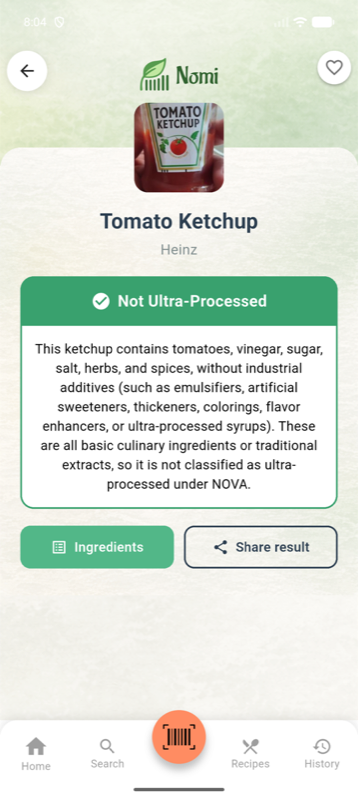
Nomi scan result screen

Product information comes from public databases and Nomi's own analysis, and may contain errors. Always check the packaging. Ultra-processed classification is based on the NOVA food processing system.

Nomi — UPF Scanner Free on iOS & Android
Get the app