
Nomi
UPF Food Scanner
Know what’s really in your food
Get the free app

Yes — Ramen Chinese stir-fry noodles is ultra-processed.
The product is classified as ultra-processed because it contains modified tapioca starch, which is an industrially processed starch ingredient, and sodium alginate, a stabilizer. Both are extracted/modified additives characteristic of ultra-processed foods under NOVA.
Other pasta, rice & noodles Nomi has checked — these ones aren't ultra-processed.
 Fine Egg Noodles
Blue Dragon
Not UPF
Fine Egg Noodles
Blue Dragon
Not UPF
 Gnocchi
Chef select
Not UPF
Gnocchi
Chef select
Not UPF
 Skinny Noodles
Yumsu
Not UPF
Skinny Noodles
Yumsu
Not UPF
 Giant Couscous
By sainsbury's
Not UPF
Giant Couscous
By sainsbury's
Not UPF
 Medium Egg Noodles imp
Sharwood's
Not UPF
Medium Egg Noodles imp
Sharwood's
Not UPF
 Tomato lentils
Lidl
Not UPF
Tomato lentils
Lidl
Not UPF
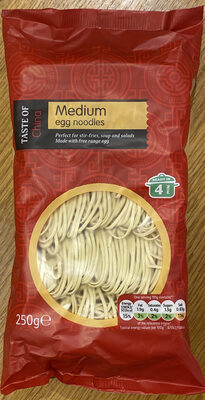 Medium Egg Noodles
Taste Of,Lidl
Not UPF
Medium Egg Noodles
Taste Of,Lidl
Not UPF
 Wholegrain Rice
Tesco
Not UPF
Wholegrain Rice
Tesco
Not UPF
 Medium Egg Noodles imp
Blue Dragon
Not UPF
Medium Egg Noodles imp
Blue Dragon
Not UPF
 Sainsburys Basmati Rice
Sainsbury's,Sainsburys
Not UPF
Sainsburys Basmati Rice
Sainsbury's,Sainsburys
Not UPF
Yes — Ramen Chinese stir-fry noodles by Tiger Tiger is ultra-processed, so it counts as a UPF (ultra-processed food). The product is classified as ultra-processed because it contains modified tapioca starch, which is an industrially processed starch ingredient, and sodium alginate, a stabilizer. Both are extracted/modified additives characteristic of ultra-processed foods under NOVA.
Ultra-processed foods (UPFs) are industrial formulations made with ingredients and additives you wouldn't find in a home kitchen — such as emulsifiers, artificial flavourings, colourings and modified starches. The classification is based on the NOVA system used by researchers and dietitians worldwide.
Scan any barcode — or photograph the ingredients label — with the free Nomi app for iOS and Android. You'll get an instant ultra-processed verdict with every ingredient explained in plain English.
This page was shared from Nomi, the free app that tells you instantly whether any food is ultra-processed.
Free download · No subscription needed to start scanning
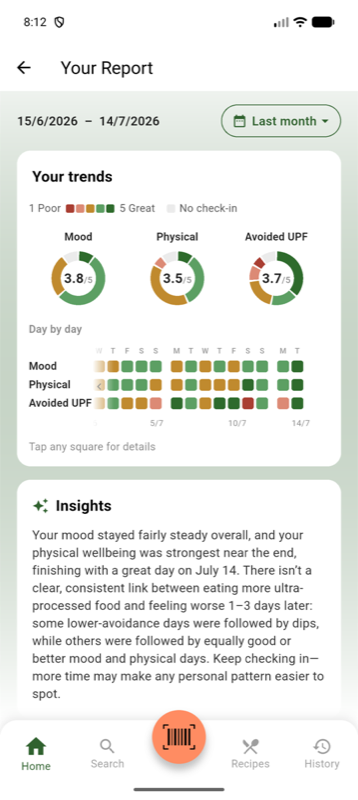
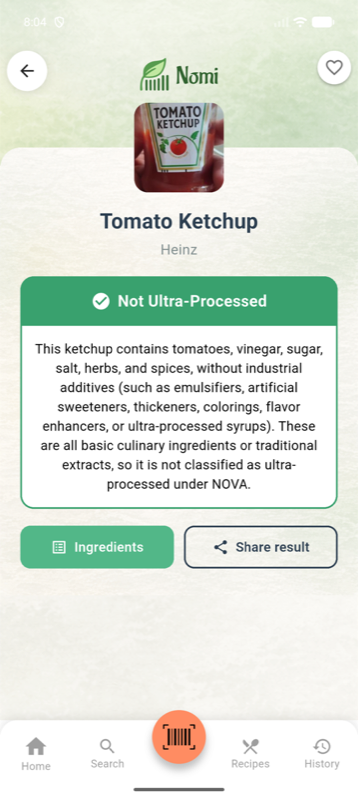
Product information comes from public databases and Nomi's own analysis, and may contain errors. Always check the packaging. Ultra-processed classification is based on the NOVA food processing system.