Nomi
UPF Food Scanner
Know what’s really in your food
Get the free app
Sour Cream and Onion by Pringles
Pringles

Sour Cream and Onion

Barcode 5053990179039
Scanned  33  times by Nomi users
Ultra-Processed Food (UPF)

Yes — Sour Cream and Onion is ultra-processed.

This product is ultra-processed because it contains several industrial ingredients and additives, including maltodextrin and dextrose (industrial refined sugars), modified maize starch, flavour enhancers such as monosodium glutamate, disodium guanylate, disodium inosinate, and yeast extract, plus milk protein, an emulsifier, E471 (mono- and diglycerides), colour, and annatto norbixin. These ingredients indicate an industrial formulation characteristic of NOVA ultra-processed foods.

Ingredients

10 ultra-processed markers
  • OK
    dehydrated potatoes
    Powdery or granulated dried potatoes obtained by removing water, used as a base or extender in snacks and mixes.
  • OK
    sunflower oil
    A neutral-tasting culinary oil pressed from sunflower seeds, rich in unsaturated fats and commonly used for frying and dressings.
  • OK
    wheat flour
    Finely ground cereal flour from wheat; a fundamental baking ingredient.
  • OK
    corn flour
    A fine, white powder made from ground corn, used as a thickener in sauces, soups, and baking in some regions (note: in some countries corn flour refers to cornstarch).
  • OK
    rice flour
    A finely milled flour from milled rice, commonly used as a gluten-free thickener or flour substitute in baking and cooking.
  • OK
    wheat starch
    Starch extracted from wheat grain, used as a thickener, filler, or texture modifier in foods.
  • UPF
    maltodextrin
    A white powder made from starch that has been partially hydrolyzed; used as a thickener or filler and widely used as a food additive.
  • OK
    salt
    Common mineral compound (sodium chloride) used as a seasoning and preservative across cuisines.
  • OK
    onion seasoning
  • UPF
    dextrose
    A simple sugar derived from glucose. Commonly used as a sweetener and source of quick energy in foods.
  • OK
    onion powder
    Dried and ground onion used as a seasoning to impart onion flavor.
  • UPF
    modified maize starch
    A processed starch, often used as a thickener or binding agent in foods; may be treated to modify properties.
  • OK
    sour cream powder
  • OK
    lactose
    A disaccharide sugar derived from milk (glucose + galactose). Common dairy carbohydrate.
  • OK
    whey powder
    Powder derived from whey, the liquid byproduct of cheese production, rich in whey proteins and commonly used as a protein supplement or functional ingredient.
  • OK
    buttermilk powder
    Dried buttermilk obtained from fermented milk; used as a dairy ingredient to provide dairy flavor and proteins in products.
  • OK
    flavour enhancers
  • OK
    monosodium glutamate
  • UPF
    disodium guanylate
    A nucleotide-based flavor enhancer often used as a synergist with MSG in processed foods.
  • OK
    disodium inosinate
  • OK
    citric acid
    A weak organic acid found in citrus fruits, commonly used as an acidulant and preservative in foods and beverages.
  • OK
    malic acid
    An organic acid used as a acidity regulator and flavouring component in foods; often derived from natural sources.
  • OK
    oat fibre
  • OK
    sweet whey powder
  • OK
    lactic acid
    A naturally occurring organic acid used as an acidity regulator and flavoring in foods.
  • UPF
    yeast extract
    A flavor-enhancing extract produced from yeast cells, rich in amino acids and natural glutamates, commonly used to augment savory flavors.
  • OK
    sugar
    Granulated sugar derived from sugarcane or sugar beets; a basic, single-ingredient sweetener.
  • OK
    acid
  • OK
    sodium diacetate
  • UPF
    milk protein
    Protein derived from milk (e.g., whey or casein); a processed isolated protein ingredient.
  • UPF
    emulsifier
    A generic food additive that helps blend ingredients with different phases (oil and water); often an industrial or processed ingredient.
  • UPF
    mono- and diglycerides
    A common food additive used as an emulsifier made from glycerides of fatty acids; often derived from vegetable fats. It helps improve texture and shelf-life.
  • UPF
    colour (color)
    A broad category of additives used to impart or enhance color in foods. Can be artificial or natural: includes tartrazine, sunset yellow, caramel color, etc.
  • UPF
    annatto, norbixin
    Annatto and norbixin are natural food colorants derived from tropical seeds used to impart yellow-orange colours in foods.

Swap it for something less processed

See all Crisps, Snacks & Nuts →

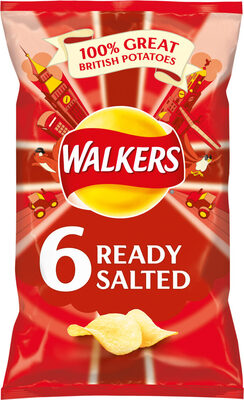
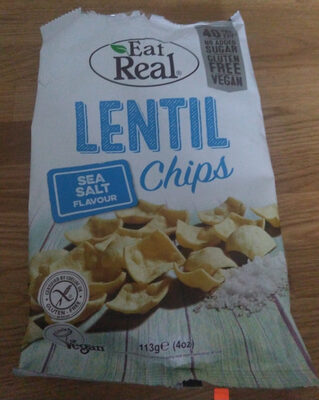
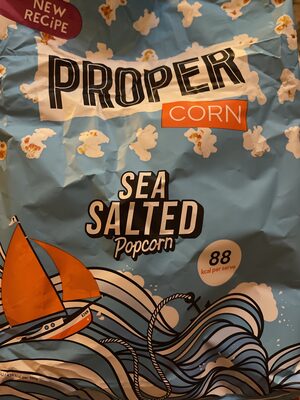
Other crisps, snacks & nuts Nomi has checked — these ones aren't ultra-processed.

Common questions about Sour Cream and Onion

Is Sour Cream and Onion ultra-processed?

Yes — Sour Cream and Onion by Pringles is ultra-processed, so it counts as a UPF (ultra-processed food). This product is ultra-processed because it contains several industrial ingredients and additives, including maltodextrin and dextrose (industrial refined sugars), modified maize starch, flavour enhancers such as monosodium glutamate, disodium guanylate, disodium inosinate, and yeast extract, plus milk protein, an emulsifier, E471 (mono- and diglycerides), colour, and annatto norbixin. These ingredients indicate an industrial formulation characteristic of NOVA ultra-processed foods.

Which ingredients in Sour Cream and Onion are ultra-processed?

Nomi flags 10 ingredients in Sour Cream and Onion as ultra-processed markers: maltodextrin, dextrose, modified maize starch, disodium guanylate, yeast extract, milk protein, emulsifier, mono- and diglycerides, colour (color), annatto, norbixin. See the full ingredient breakdown above for what each one is.

What does "ultra-processed" (UPF) mean?

Ultra-processed foods (UPFs) are industrial formulations made with ingredients and additives you wouldn't find in a home kitchen — such as emulsifiers, artificial flavourings, colourings and modified starches. The classification is based on the NOVA system used by researchers and dietitians worldwide.

How can I check whether other foods are ultra-processed?

Scan any barcode — or photograph the ingredients label — with the free Nomi app for iOS and Android. You'll get an instant ultra-processed verdict with every ingredient explained in plain English.

BBC As seen on The One Show

Scan it yourself,
right in the aisle

This page was shared from Nomi, the free app that tells you instantly whether any food is ultra-processed.

  • Scan any barcode — or photograph the ingredients label
  • Every ingredient explained in plain English
  • Daily check-ins show how food affects how you feel
  • Save favourites and build a healthier shopping list

Free download · No subscription needed to start scanning
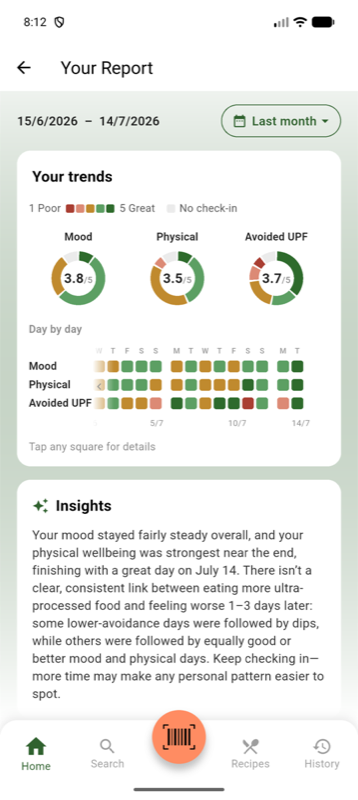
Nomi monthly wellbeing report
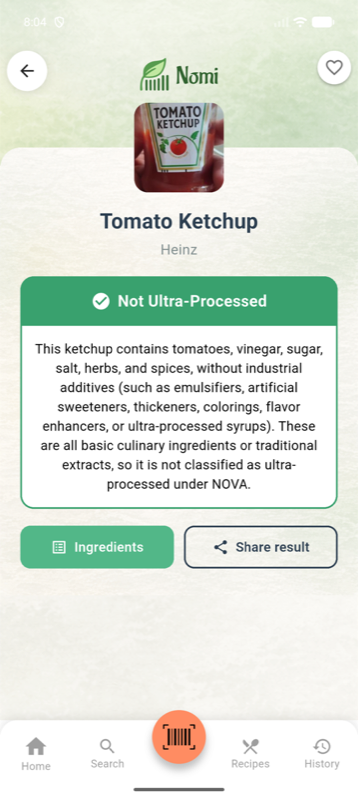
Nomi scan result screen

Product information comes from public databases and Nomi's own analysis, and may contain errors. Always check the packaging. Ultra-processed classification is based on the NOVA food processing system.

Nomi — UPF Scanner Free on iOS & Android
Get the app