
Nomi
UPF Food Scanner
Know what’s really in your food
Get the free app
Yes — chilli pesto is ultra-processed.
This is ultra-processed because it contains refined soybean oil and paprika extract, an isolated colour additive. The refined oil is an industrially processed fat, and paprika extract is an extracted additive used for colouring. These ingredients classify the product as UPF under the stated NOVA criteria. Lactic acid, citric acid, and ascorbic acid are basic acidity regulators/antioxidants and are not the reasons for the classification.
Other sauces, condiments & spreads Nomi has checked — these ones aren't ultra-processed.
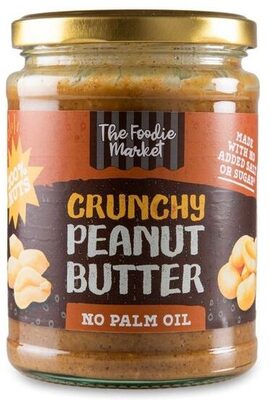 Crunchy Peanut Butter
The Foodie Market
Not UPF
Crunchy Peanut Butter
The Foodie Market
Not UPF
 Tomato Ketchup
Heinz
Not UPF
Tomato Ketchup
Heinz
Not UPF
 Tomato Ketchup
Heinz
Not UPF
Tomato Ketchup
Heinz
Not UPF
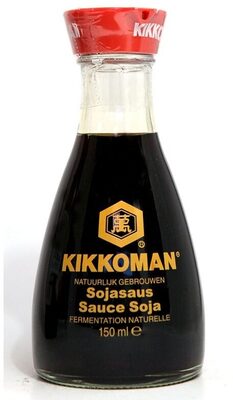 Soy Sauce
Kikkoman
Not UPF
Soy Sauce
Kikkoman
Not UPF
 Nutritional Yeast Flakes
Engevita
Not UPF
Nutritional Yeast Flakes
Engevita
Not UPF
 Tomato Ketchup BIO
Heinz
Not UPF
Tomato Ketchup BIO
Heinz
Not UPF
 Crunchy Peanut Butter
Meridian, Meridian Foods
Not UPF
Crunchy Peanut Butter
Meridian, Meridian Foods
Not UPF
 Soy Sauce
Kikkoman
Not UPF
Soy Sauce
Kikkoman
Not UPF
 Salsa di Soia
Kikkoman
Not UPF
Salsa di Soia
Kikkoman
Not UPF
 Tomato Passata
Baresa
Not UPF
Tomato Passata
Baresa
Not UPF
Yes — chilli pesto by Sainsburys is ultra-processed, so it counts as a UPF (ultra-processed food). This is ultra-processed because it contains refined soybean oil and paprika extract, an isolated colour additive. The refined oil is an industrially processed fat, and paprika extract is an extracted additive used for colouring. These ingredients classify the product as UPF under the stated NOVA criteria. Lactic acid, citric acid, and ascorbic acid are basic acidity regulators/antioxidants and are not the reasons for the classification.
Ultra-processed foods (UPFs) are industrial formulations made with ingredients and additives you wouldn't find in a home kitchen — such as emulsifiers, artificial flavourings, colourings and modified starches. The classification is based on the NOVA system used by researchers and dietitians worldwide.
Scan any barcode — or photograph the ingredients label — with the free Nomi app for iOS and Android. You'll get an instant ultra-processed verdict with every ingredient explained in plain English.
This page was shared from Nomi, the free app that tells you instantly whether any food is ultra-processed.
Free download · No subscription needed to start scanning
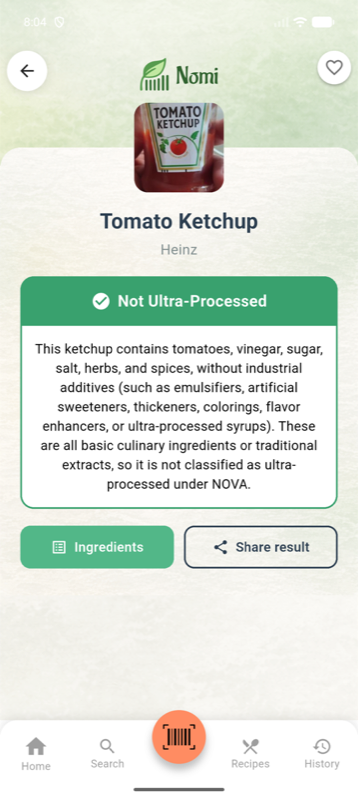
Product information comes from public databases and Nomi's own analysis, and may contain errors. Always check the packaging. Ultra-processed classification is based on the NOVA food processing system.